Honeyeater Review
Behind the Scenes Bookclub
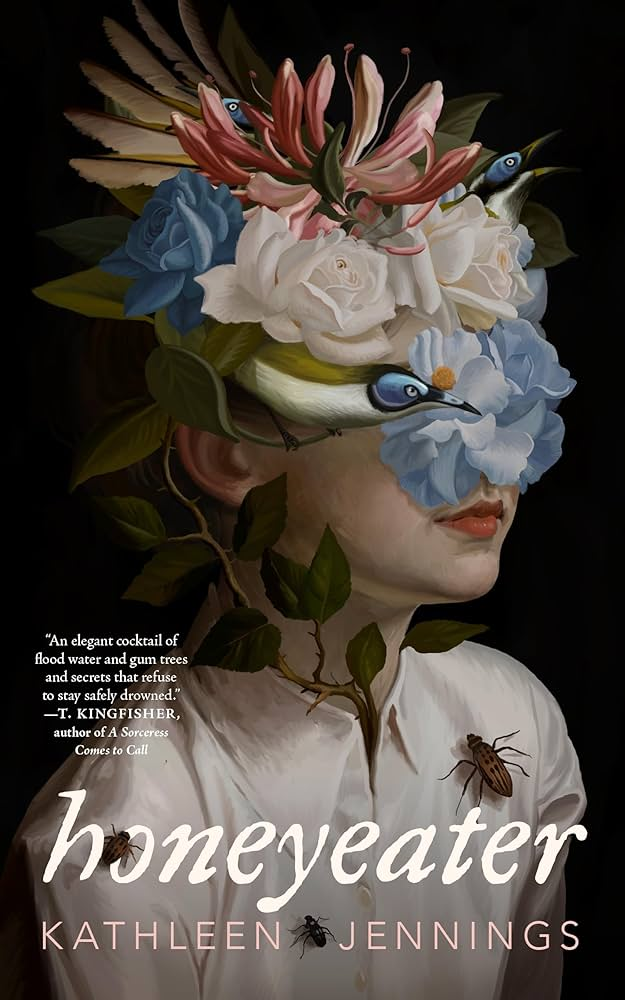
April Book of the Month: honeyeater
Reviewed by Dani Ringrose
Kathleen Jennings is Jacaranda Journal’s guest reader at our first salon for the year! Catch her art and reading from her work at Echo and Bounce in Woolloongabba on May 04, free RSVP here!
My Brisbane street flooded during the 2011 floods. Even after weeks of rain, the water levels moved languidly, a modern gothic uncanny force. It crept out of drains, brown riverine water, carrying sediment and detritus. Brisbane floodwaters may be easier than cyclones or fires to escape, but as the waters’ tongued edges lapped along suburban streets, they felt unstoppable.
Honeyeater, the 2025 urban gothic novel from Brisbane writer Kathleen Jennings, takes this muddy, eddying menace and infuses it with a heady, floral dizziness. It is an exploration of familial obligations, tangled memories and ghosts that won’t stay dead.
The setting of this novel is the fictional town of Gowburgh, a thinly veiled stand-in for Brisbane and its ‘ibis-haunted floodplains’. Those who live along the tentacled reaches of Oxley Creek on Brisbane’s southside—Yeronga, Teneriffe, Graceville, Oxley—will recognise its watery double and the unusual neighbours who appear in this story. Bellworth Creek is a personified force of nature which
finally choked on itself… retched mud, which sprouted teeth, clawed free of weeds, vomited out its own water, and become not-creek. Wet leaves tightened around a restless musculature of vines. It opened its eyes.
Floodwaters can easily snatch things away from us. Relics that are precious to us, things we would rather have sink to the bottom. The protagonist, Charlie Wren, driftless and aimless, is drawn back to his dead aunt’s house along Bellworth Creek. Charlie’s past is littered with missing acquaintances, but that isn’t why he’s returned. He’s come to his aunt’s house to clean it out for good before trying to finally make something of his itinerant-self somewhere else. Which, of course, has nothing to do with the fact that the police are keeping a lazy eye on him.
Charlie’s plans are turned askew as a strange woman appears on the doorstep of the house. Grace is as much a mystery to herself as she is to Charlie. She is an enchanting yet troubled character. For most readers, she is likely to be the most intriguing character, especially after thorny rose vines begin appearing from under her skin, ripping and tangling their way out. The best, witchy descriptions are saved for her transforming appearance:
The lamp, swaying, made her skull look the wrong shape. Blue flowers, grown larger, climbed into her hair and spilled over her shoulder. On her back… that first wound had spread and torn. Its grey fibres frayed like palm matting. Underneath, instead of veins or muscle, wasa a net of blue-green vines. The colours reminded him of the pigeon, and the way it pulled apart—
Like many other gothic narratives, there is often a strong borrowing from the vernacular and tempo of fairy tale and folklore. Jennings uses the stylistics of these genres to make this contemporary tale feel unmoored in time, forcing readers to question what is real.
To add to this folklore-esque atmosphere, the narrative is interrupted by one-page fables or urban myths, narrated as though your grandma is trying to creep you out again with a tale she was told as a little girl. They feel adjacent to the narrative rather than explicit, and are welcome interludes between the dreamlike story.
The themes of the novel, memory and decay, are richly entangled. Everyone has questionable pasts, histories they don’t wish to confront, or a present they don’t understand.
The names of the missing begin to pile up—Alli and her recent, abrupt disappearance; Lydia Damson, childhood friend; Micah, uni buddy—it feels like not being able to see the bottom of a body of water. There’s the desire to keep moving forward, to uncover the truth about these women, to locate their bodies, to lay them all to rest, but there is an undercurrent, a feeling that the riverbed could bottom out at any moment or a bull shark could nip your ankles. The creek’s waters become the key source of mystery and the return of the repressed: ‘[b]ut traffic with the creek isn’t one way. Sometimes things come back. Things, not people.’
Those who worked in the cleanup after those floods—the Mud Army—will tell you of the stench; the sticky clinginess of the mud and silt weeks after the water subsided. The mud was quickly power-hosed from neighbours’ walls and floors, but the rotten smell was pervasive.
This book smells. In the best way.
Jennings’s writing is redolent with the sensory overload of the subtropics. A ripe funk of mangrove mud and indolic vines. The suburb of Bellworth is ‘garlanded with passionfruits’, the ‘vegetal reek of swamps’ and the ‘honey-butter scent of gum flowers’. The story smells of abandonment and decay, both familiar gothic tropes. It smells of the faint violets of your grandmother’s beauty cabinet and the sweetly sour dust of old books. It smells of ghosts who’ve just left the room.
The strength of Jennings’s writing is her ability to craft landscape. Her previous novella, Flyaway, was set in western Queensland where she grew up, and was shortlisted for the 2021 World Fantasy Award and the 2020 Crawford Award. It, too, captured a strong sense of place. Wrought uncanny and fantastical—yet still totally rooted in the real—Jennings’ strengths are continued in the subtropical atmosphere of Bellworth and Honeyeater.
Read if:
you want to know how many bodies wash up
you’re a fantasy fan and want to broaden your reading by trying the subgenres of Australian and suburban gothic
you love writers playing with craft and precisely plucked vocabulary
you crave sensory overload in your books
you don’t have time for a long read: this clocks in at sub-200 pages
you want to support a Brisbane author
What our readers had to say about Honeyeater:
@bettergetkraken on Instagram said,
'It's sublime. I always think of paperbark and snake skin when I think about it.'
Our Next Book
Our May pick for the Behind the Scenes Bookclub will be At the Foot of the Cherry Tree by Japanese-Australian author Alli Parker. Read along with us and send us your thoughts via email or DM on Instagram and TikTok to have them featured in the newsletter. Our review will be out in our May issue of Purple Prose Newsletter. Remember to subscribe!

Kathleen Jennings is an illustrator and writer based in Brisbane, Australia. As an illustrator, she has won one World Fantasy Award (and been a finalist three other times), and has been shortlisted once for the Hugos, and once for the Locus Awards, as well as winning a number of Ditmars. As a writer, she has won a British Fantasy Award (the Sydney J Bounds Award) and two Ditmars and been shortlisted for the World Fantasy Awards, the Locus Awards, the Courier-Mail People’s Choice Book of the Year Award, the Crawford Award, the Australian Shadows Award, the Eugie Foster Memorial Award, and several Aurealis Awards. She has an MPhil and a PhD in Creative Writing. See more of her here.

Dani Ringrose is a sub-editor and salon host for Jacaranda Journal. She is studying her Masters of Writing, Editing and Publishing at UQ. Her debut literary gothic novel The Lyrebirds was shortlisted in 2025 for the Glendower Prize for an unpublished manuscript at the Queensland Literary Awards. Neither of these things would exist if she hadn’t read Kathleen Jennings’s author acknowledgements in Flyaway eight years ago.

