Purple Prose - June 2026
Updated: Jun 27
Monthly Recap and Reminders
Welcome to the June 2026 issue of Purple Prose—Jacaranda Journal’s monthly online newsletter. Purple Prose creates a regular platform for our readers, where we discuss all things writing and arts, give recommendations, feature local creatives, and provide a glimpse behind the scenes to see what the Jacaranda team are up to. A quick note for returning readers: Jacaranda will now be released at the beginning of each month, rather than the end of each one (just in case you wondered what happened to our May edition).
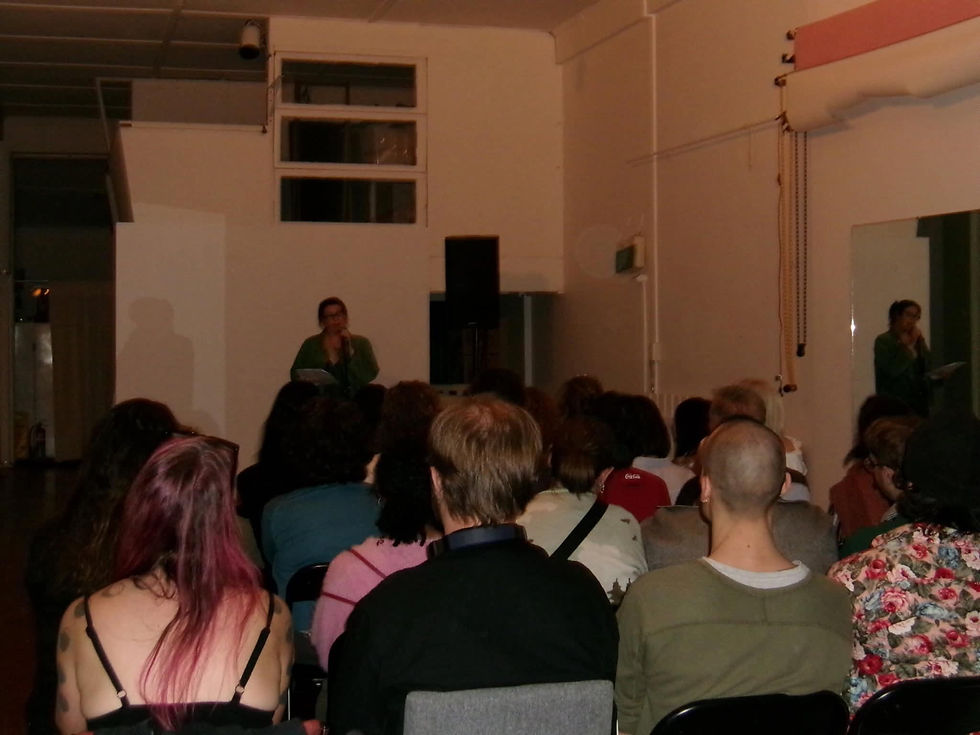
In the past month, the Jacaranda team hosted the first Salon of 2026. Alongside eating ramen and drinking fun beverages, attendees had the opportunity to view and purchase some incredible artwork, including zines, prints, crochet animals, and more. We were kept entertained listening to amazing speakers read their poetry, fiction, and non-fiction. And of course, we made new friends and mingled with fellow artists, writers, and creatives. If you missed it or are keen to experience it all again, stay tuned for more Salons later in the year!
The June issue of Purple Prose includes a new essay by our columnist Jemma Green in The Writer’s Rant, where she examines cancel culture and the possibility of separating art from the artist. Next, we provide a range of diverse and seasonal recommendations—whether you’re looking to find new music, books, or food, the Jacaranda team has you covered. We feature an exciting Creative Spotlight with the brilliant author of Honeyeater and illustrator of The Cruel Prince books, Kathleen Jennings. And in our Behind the Scenes Bookclub, we take a detour from our anticipated review of At the Foot of the Cherry Tree by Alli Parker (which will instead be appearing in a future review soon along with an exciting surprise!), and instead we review some short fiction in Claire Keegan's Small Things Like These.
What’s coming up in June?

Jacaranda Journal 13.1 Breaching Boundaries is almost here! To celebrate all the hard work and talent that has gone into the upcoming issue, our Launch Event is on Thursday the 25th of June at UQ St Lucia’s Global Change Institute. You are invited to come and hang out, have a drink, and celebrate our published authors, artists, and creatives. Tickets are available now on our website! Starting from $0, tickets are sold on a pay-what-you-want basis. The ticket includes free food, alcoholic and non-alcoholic beverages, and an entry into our raffle.
Also happening in June, the author of the next issue of the Quarterly Essay, Anna Goldsworthy, will be in-conversation with author John Birmingham. This dazzling essay, The God We Made, explores the implications of AI for art, culture, and the self. This event will be held at Avid Reader on Tuesday the 23rd of June.
Lifeline Bookfest will return on Saturday the 27th of June! Over five huge days, you will find all kinds of pre-loved fiction, non-fiction, comics, magazines, and more. Every book you buy helps support the 24-hour Lifeline Crisis Support Line.
Though not literary-related, we also thought it important to let you know about the Tattoos 4 Trans Rights fundraiser event! If you’ve been thinking about new tattoos. This is your sign. On the 20th and 21st of June at Just Upstairs Tattoo Studio in Stones Corner, over a dozen artists are offering flash pieces at a discounted price. All proceeds will be going to mutual aid for gender-affirming care. To find out more, check out their Instagram @t4t_flashday!
Our New WellRead Collaboration

There’s something strangely lovely about receiving a book you didn’t choose yourself.
Maybe it’s the surprise of it all, or maybe it’s simply the excuse to step outside your usual reading habits for a while. Either way, we’ve recently found ourselves very taken with WellRead, an Australian book subscription service that curates and delivers newly released literary titles each month.
They thoughtfully select new release literary fiction—the kinds of books that quietly consume your weekend before inevitably being recommended to at least three friends afterwards.
As a journal constantly surrounded by emerging voices, independent publishing, and ever-growing TBR piles, there’s something about WellRead that feels especially aligned with the way we love engaging with literature: slowly, curiously, and with a sense of discovery.
For us, that sense of discovery feels especially close to what small literary spaces do best: making room for stories that might otherwise slip quietly past us. Whether through a journal, a newsletter, or a carefully curated book subscription, there’s something lovely about being led towards writing you may not have found on your own.
And honestly, there’s also just something nice about books showing up at your doorstep each month. Consider this your sign to romanticise your reading life, just a little.
The raffle winner at our Breaching Boundaries launch will receive a 6-month subscription to WellRead. So, secure a ticket via our website here for the chance to win six free hand-picked books!
There’s plenty to look forward to in Brisbane’s literary and arts world in the upcoming month! To stay up to date on all things happening at Jacaranda Journal and in the broader creative community, please follow us on TikTok and Instagram, as well as share and subscribe to Purple Prose!
The Writer’s Rant
Separating the Art from the Artist
By Jemma Green
I feel like no one talks about the gut-wrenching disappointment of learning that your favourite artist is a terrible person. The day I found out that Neil Gaiman had been accused by multiple women of sexual assault, coercion, and harrassment, I threw my copy of Good Omens across the room. I reconsidered if my favourite movie should still be Coraline. I let out a deep, deep sigh… Can’t have anything nice.

Neil Gaiman, very justly, had been ‘cancelled’. Just one of the many authors, musicians, actors, and artists whose problematic behavior, bigoted political views, or literal crimes (as in this case) have come to light and led to their public cancellation. And just one of many moments where I have had to ask myself: is it okay to still like this person's stuff?
This is an issue I think we all face from time to time—whether we think it’s right to continue engaging with a creative work when the creator has since been cancelled.
For those who aren’t aware (if so, do you just not have the internet?), cancel culture is the ‘attitudes within a community which call for or bring about the withdrawal of support from a public figure’. People are cancelled on large scales for illegal actions—such as the children’sauthor Craig Silvey, who very recently pled guilty to child exploitation and whose books have been removed from shops and schools across the country—and people are cancelled in online spaces for their political views—such as Harry Potter author J.K. Rowling, who continues to be openly transphobic online.
There’s an element of morality in cancel culture, to be sure. Silvey’s works, for instance, take on a nauseating light when seen through the lens of his crimes. Rowling’s works are easily re-examined for her biases and bigotry. But I believe there is also a sense of peer pressure. Wondering, will I be criticised if I keep reading that author’s books? Will I be doxxed for listening to that band’s music?
On the whole, everyone deals with cancel culture’s impact differently. Many instigate it, uphold it, speak out about and give platform to it. Many submit to it, tossing out any paraphernalia they owned which was created by the cancelled artist in an effort to remain virtuous. And then there’s the many who agree that the artist should be cancelled, condemn their behaviour, but continue to indulge in their work. These people will often tell you that you must learn to separate art from the artist.
When I hear this phrase, I often imagine the self-portait of Van Gogh; the one where his ear is missing. I imagine him stepping out of the painting, each messy brushstroke moving, and leaving behind a plain background of solid colour. Of absence. If there is no Van Gogh in that painting, there is no painting. And I feel that sentiment is true for all art, regardless of whether or not you can actually see the artist in it. They made it—they’re still there. Especially when it comes to writers.

It is an intimate act; a seeing into a soul. To read what a person has written is to understand the rhythm of their thoughts and the motivations of their heart. Like people, writing is corruptible. Nothing is created in a vacuum. and the act of arranging, penning, and publishing words is inherently influenced by the biases and beliefs of the one holding the pen.
In Babel, for example, RF Kuang—through her fictional characters—explains that translation between languages is political, alterable, and colonisable. White Europeans would often mistranslate the myriad languages of people of colour to serve their own agendas and create certain perceptions. Kuang tells us that no translation exists without the influence of the translator. Writing is the same. No writing exists without the writer—no art exists without the artist.
You’ll find examples of that in every author’s work. It can be as simple as a writer who frequently starts their sentences with the word ‘and’ (as I have done a lot in this article). A study from the London School of Economics and Political Science found that writing style was both ‘individual and persistent’, unique and consistent throughout a lifespan. Writers use the same patterns, the same techniques, because it is what makes sense to them. It is also why so much of writing differs. Sally Rooney’s sparse, staccato-like style is vastly different to George R.R. Martin’s long-winded descriptions.
The writer’s presence in their work can also be a complex integration of beliefs. Many people discuss the influence of Brandon Sanderson’s Mormon faith on the worlds of his bestselling fantasy series. It’s no secret that CS Lewis wrote The Chronicles of Narnia as a Christian allegory, or that JK Rowling’s more bigoted views are present in the naming and creation of the Harry Potter characters (I mean, calling a Black character Kingsley Shaklebolt and making an Irish character famous for blowing shit up is WILD).
All this to say that writers are inherently a part of their writing. We are woven invisibly between letters—our words, our fingerprints. Our characters, everything they experience, comes fragmented from everything we are and will be. So to be blunt: no, I will not separate art from the artist. And neither should you.
I won’t tell you to stop reading that cancelled author’s book or to stop watching that actress’ movies. That is your decision. I don’t believe that there’s a single answer to this complex question. It always depends, case by case. But if you choose to continue engaging with art that has been made by a person who has done bad things, own it. Understand it. And understand what it says about you. Have those hard conversations with yourself to decide where you stand and always be critical, be discerning.
Because to read with your eyes closed is to not read at all.

Jemma Green is an emerging writer and editor based in Magandjin/Brisbane. She has a BFA in Creative Writing from QUT, her work has been featured in multiple publications, and she currently works as both an intern with the publisher Riveted Press and as the Co-Head of Social Media and Marketing at Jacaranda Journal. Artistically, her focus lies in exploring humanness and connection.
Tiktok: @jemmaawritess
Instagram: @girlinhertwentiess
Check out more of her writing here.
JJ Recs
We're leaning into mist-shrouded, wintery vibes with this month's team recommendations. Think your breath fogging in the morning cold, dew drops sliding down a windshield, toes wriggling in fluffy socks. Enjoy.

Calico by Ryan Beatty—Recommended by Cris Bonquin, Arts and Culture Liaison
No God But Us by Bobuq Sayed—Recommended by Kiv, Subeditor
This novel begins with a drag queen getting sucked off, and that should be all you need to go buy it. Happy Pride!
Looking Presentable—Recommended by Josep Grew Figuerola, Production Assistant
A TTRPG that recently won an award for Best Rules at the Indie Groundbreakers Awards from IGDN! It also plays really fun. I love the aesthetic of it all being a "zine" that you can fold up and so forth.
Winter Bird by AURORA—Recommended by Euri Glenn, Publisher and Editor in Chief
Parsley, Sage, Rosemary and Thyme by Simon and Garfunkel—Recommended by Lilian Martin, Head of Production
A poetic lil album with many songs with autumn vibes.

If It Makes You Happy by Julie Olivia—Recommended by Millie Biggs, Co-Head of Social Media and Marketing
A very autumnal romance set in the 90s.
The Stoner by John Williams—ALSO recommended by Millie Biggs, Co-Head of Social Media and Marketing
A classic campus novel with wintery vibes.
Boondall Wetlands—Recommended by Jemma Green, Co-Head of Social Media and Marketing
This nature reserve in Boondall is a gorgeous place for a cold morning walk. Surrounded by towering trees, sweeping vines, mossy logs, clover grass, and natural wildlife. I love to cosplay an old Scottish woman traversing the misty highlands here.
Creative Spotlight
Maps, Mist, and Whimsy:
An Interview with Kathleen Jennings
When I interviewed Kathleen Jennings, it was a surreal, anxiety-inducing, and eye-opening experience. I had never interviewed anyone face-to-face before. Anything I’d done went through email with the impenetrable barrier of Kind Regards standing between myself and my subject. To have my very first in-person interview be with an internationally successful author—and the illustrator of my favourite book series of all time—meant there was pressure. A lot of pressure.
I remember receiving Jennings' reply to the email I sent, asking for the interview. I was at work, on a Thursday, on my break, and she asked if we could meet the following morning. I, of course, said yes and then spent my night afterwards trying to figure out what questions to ask her. I wrote them down. I crossed them out. I wrote them again. I nitpicked whether they were too simple, too niche, too stalkery, too boring. Would she know I had no idea what I was doing? That I was cosplaying as a writer/interviewer? I fell asleep with my notebook on my lap, pen in hand.
And when my alarm went off at 6am, I drove over an hour to Lakeside Cafe at UQ with lukewarm coffee in my travel cup and sleep in my eyes and two pages of scribbled questions ready to fire off. And so, like the protagonist leaving home to set out on a quest, it began.
JJ: You’re an author and an artist—which do you consider yourself more?

Jennings: It depends; it goes day to day. When I’m writing, I have never heard of visual imagery, and after I have turned in a draft, I think ‘what is the English language?’. I love them both, I swap between them fairly regularly and I try to blend them, so the techniques and the way I think about them. I’m always looking at ways to summarise that, so that if I’m giving advice or an exercise it would work for writers or illustrators. They’re both storytelling, so I often say ‘drawing from the same aquifer through different worlds’, and I just ran back and forth between them according to my deadlines.
JJ: You’re someone whose creative career is built on transdisciplinary work. How do you balance these two different aspects of your creativity? Do you find that there’s room for overlap or does one tend to dominate the other?
Jennings: There’s a lot of room for overlap both in doing them at the same time and in combining them into projects. They coexist pretty well as far as running two careers and I can often combine them in a project. Within those individual projects, however, it’s very easy, unless I’ve actually been commissioned to do a piece that is written and illustrated, to go ‘what if I just push it a bit further, add more pictures, put in fewer words’ and then suddenly I have a purely visual story.
Or occasionally I will write a draft of a story as a continuous line drawing of everything that happens and then type up the draft and then it won’t be an illustrated story. They compete in an individual project unless I have some parameters that will keep them in check. They also compete in terms of time management, they operate on very different timescales and managing that can be quite tricky—one has lots of little back and forth stages on an illustration project and quite a short-term deadline, whereas a book has a longer deadline and a lot more time that is all-consuming.
JJ: I did a little stalking on your website—it says you’ve won multiple Dimitar awards for both your professional and your fanart. As someone who started out writing with fanfiction myself, I have a huge appreciation for fandom. I would like to ask, what fandom was your art created for? What role have fandom spaces played in pursuing your career?
Jennings: Mostly I’ve done fanart rather than fan writing which I love and adore—I was scarred by a ‘Labyrinth’ sequel fanfic that was so good, and they never finished it, and so now I mostly just parse fandom recommendations. In terms of my fan illustrations, a lot of my work was focused around a Dalek comic where I would replace book titles with Dalek and then illustrate it—little pen and ink drawings. I don’t do as much fan art technically now except that I get to illustrate a lot of books and projects and fairy tales that I love, so it’s sort of fan art.
JJ: I’m gonna sneak my guilty pleasure question in here—'The Cruel Prince' series. Your maps in those books are so beautiful and unlike any other maps I’ve seen in fantasy books. They’re so whimsical and fun. In creating those maps, what was your vision and what influences did you draw on?

Jennings: I’ve always loved maps in books and have quite a large collection of them. There was a wonderful book which came out a couple of years ago and it got shortlisted for the World Fantasy Awards on ‘fantasy maps from novels’ paired with essays by wonderful writers. I grew up with those, like the Chronicles of Narnia and Pauline Baynes’ maps. Those were my first love. They’re so full of little images and that’s what I always loved.
I appreciate a good accurate map, but that’s not what I wanted to draw. I love the idea of a map that’s a glimpse from above the story, and you can just parachute into it so it gives you an idea of the world you’re going into, not necessarily geographically accurately. I sort of had to design the geography for[The Cruel Prince]. We went through a few stages back and forth—like thinking about how accurate to the geography of the rough area where the shifting isles exist, should it look like those glacial fingers dragging through mud, should we go for a fantasy spiral, etc.
The reference I was given for that one included a photo of an island from the side which is not the only time—authors tend to give me landscape photos or side-on views of things. There was a lot of wanting to fill it with imagery and it was that sense in the Voyage of the Dawn Treader where they’re given a map which if they look really closely has little moving illuminations of the things they’ve described passing on their journey.
JJ: That’s definitely the vibe that The Cruel Prince maps give because you’ve got the little characters—little Jude and the horses, the dragonflies etc.
Jennings: The two little goblin Fae creatures are my favourite. The art for the books – there are so many wonderful illustrations and I’m aware my work is fairly whimsical. Holly kept pushing me to add more skulls etc. – more whimsical death. I love doing that style of map.
JJ: It looks excellent. It gives you that sense of taking a peek into the actual story. I don’t think those books could’ve had maps done by anyone else.
JJ: Speaking now as a writer, from your debut novel ‘Flyaway’ through to your latest release ‘Honeyeater’, if you could sum it up in one word, how would you describe your publishing journey?
Jennings: I’ve never thought about that before—I think probably a little bit enchanted. I feel like I’ve been treated very kindly, which is weird to say given that the first book came out smack in the middle of lockdown when everyone was figuring out how to do online book launches and I couldn’t travel to promote it.
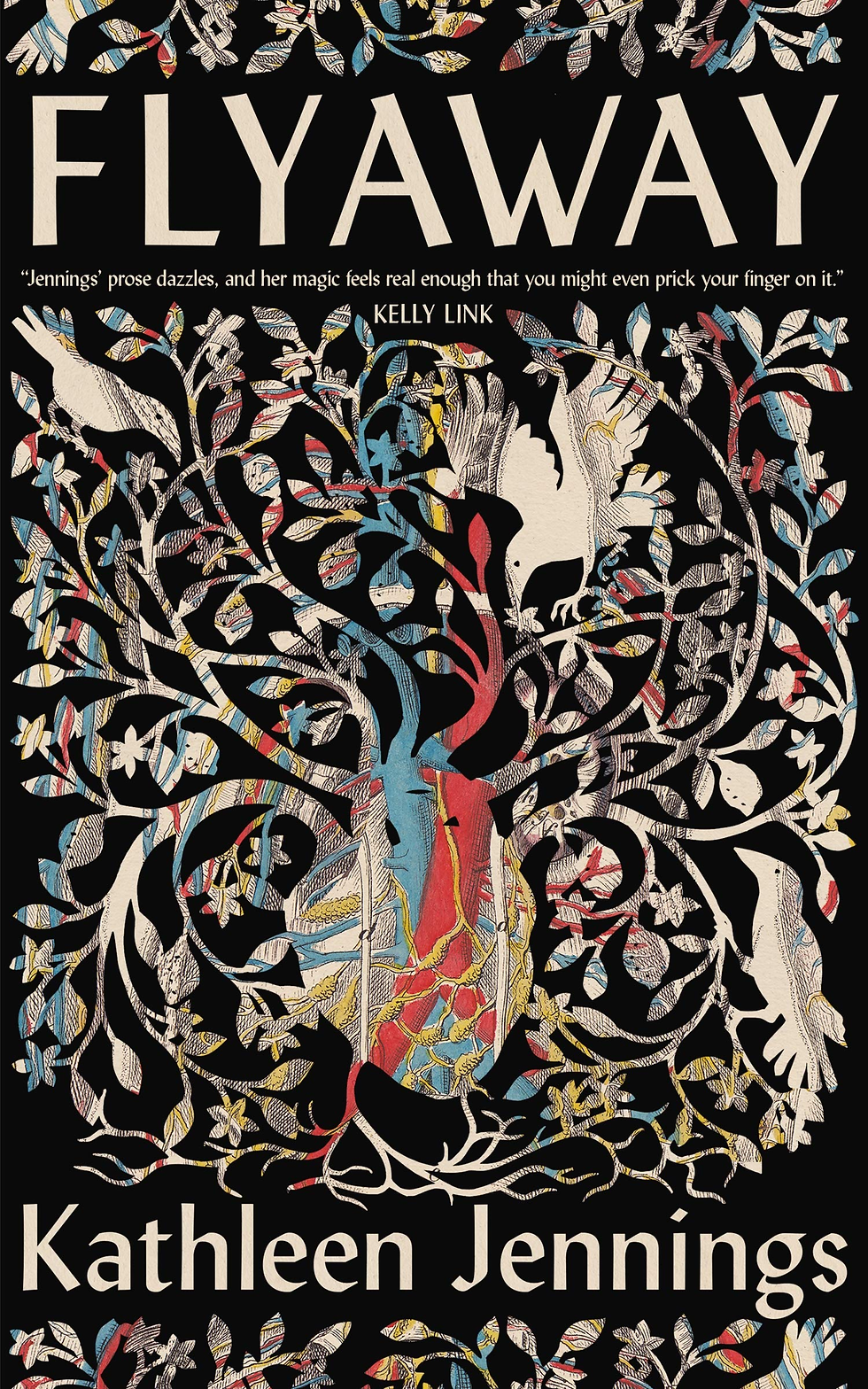
And then the second book came out in the throes of American politics, but when are we not in the throes of American politics? It just had such wonderful design and great editors and the journey to publishing was kind of sideways—teaching writing and teaching people etiquette and what to expect—so much of it is also who you know and who you come up with a project with and who you mention as an aside and someone says they have an idea that vibe would suit with.
I had connections with Tor because of my illustrations and book covers for them which made it possible for me to talk to the editors about the work. I also had friends who I’ve illustrated for who frogmarched me around conventions going ‘you know she writes too!’.
I had a pretty good time of it and incredible cover work with Honeyeater. The blue faced Honeyeaters are perfect. I’ve been fortunate too in that I could emerge, look around, and then dive back into the waves of illustration.
JJ: ‘Honeyeater’ came out last year, so it’s still pretty fresh. Clearly landscape plays a vital role in the story—I even read one review where someone referred to it as ‘botanical horror’ which I thought was quite a cool name. What did you want readers to take away from this book and what did you want from it yourself?
Jennings: There probably are a lot of correct answers to that question, but what I was really playing with when I was writing it is I wanted to create a sense of the suburban mythic. I think there was a challenge I was setting myself. I was playing with ghosts and landscape in a very particular area—fictionalised, but it’s 95% Oxley.
But what I wanted to play with was how to make the suburban feel mythic and I’ve been playing around with little charts and going ‘what feels mythic’, like a white stag in a forest, ‘what feels really not mythic’, like a refrigerator. I would draw things along a line and work out what about each of these makes it mythic or not mythic and how to take those properties and bring it over.
Also, the idea that if you write about New York or London or Paris, there’s a whole mythology the name evokes and it’s very easy to go ‘oh why don’t I just write about a place I know in that way’ but they just don’t carry that mythic weight. I would change the names or make up names in order to defamiliarise the landscape for myself and then writing to create that sense of a mythic with unknown place names which I ended up keeping because it made it plausibly deniable.
JJ: I think a lot of Australian writers struggle with that—the ‘cultural cringe’ and not wanting to write about Brisbane when I could write about New York which people might be more interested in. It’s really cool to see you took those aspects and still decided to write about Australia.
Jennings: I think it is easy to go ‘I won’t write about it or I’ll write about it as if it were New York’ but there is work to play with when it isn’t New York. The first time I went to New York I kept going ‘look it’s the cupcake shop from Sex and the City, look it’s the courthouse from Law and Order’. Just that sense of walking through places and going ‘I’ve seen this in a show, I’ve read this in a book—people who live here, do they feel like this all the time?’. So, I had to work out how to bring that mythic nature in.
JJ: You’re a very educated individual—you have an MPhil and a PhD, and you specialised in Australian Gothic literature. It’s obvious that you’ve taken some of that and applied it in your latest book. What drew you to the Australian Gothic genre in the first place?
Jennings: I grew up in Western Queensland reading books that weren’t from Western Queensland, so doing all that work of trying to read Hound of the Baskervilles or Narnia using the visual imagery you have. I always gravitated towards the Gothic; I loved a good ghost story.
My mother would read out loud to us every night but if she was away my dad would just read Sherlock Holmes. So Hound of the Baskervilles—if you slept out on the veranda and you could hear the dingoes howl. I was quite close in age to the age that Azaria Chamberlain would’ve been who was taken by a dingo—so growing up with that story very much in the Australian psyche.
That sense of stories that we tell and carry and exist in. I love Picnic at Hanging Rock. The movie is weirdly mellow, meditative psychedelic and the book is so tiny and fast. They’re daylight Gothic. I’m not that afraid of the night but walking through the scrub knowing no one’s around and hearing twigs crack... I can freak myself out. That’s what drew me to it. I love those stories of mysteries, finding stories and trying to work out what they mean. I love that landscape. There is a real tradition of the beautiful Australian Gothic which felt a little bit underdiscussed.

Picnic at Hanging Rock or The Dressmaker, or Shaun Tan’s short stories—beautiful, daylit—I wanted to explore it. I come from fantasy and science fiction, mostly fantasy. Fantasy and fairytale and the Gothic are so closely connected.
JJ: 100%—the eerie forest, the mist, the shadows…
Jennings: I was writing in that space using visuals that I knew and so it felt like a very natural step just to go ‘okay I’m gonna commit to being Australian Gothic’. It’s fun because people who read realist and literary Australian fiction are like ‘ahh the realism’ ... whereas the fantasy readers come over and are like ‘ahh the whimsy’.
JJ: Do you think the Australian Gothic, and I suppose Australian publishing in general will continue to hold its place in an increasingly globalised book industry?
Jennings: I’m biased because I got published in America first and then Picador picked up the Australian edition. I think so—I think there is work around ‘are we name checking places or are we doing the work to create a sense of the mythic’ which needs to be consciously done. People in America keep talking about how dystopian the landscape is when it’s my ‘perfectly nice street’.
JJ: There’s that idea online of all the big spiders and the insane wildlife, etc.
Jennings: People find it very exotic. Being specific to the people in the place and the interactions famously tends to make things feel universal. I get people writing to me going ‘it feels just like my small town’ or ‘this is exactly what my suburb is like’. They do love the exotic setting. There’s a place for it but there’s always waves and trends.
JJ: It’s good to hear it from your perspective because you’ve done a lot of research into that particular genre. Being published in America, I guess you have that different perspective.
Jennings: It was great, they didn’t make me change any of the spellings, they let me keep my Australian spelling. We did have to argue a couple of phrasings though, which got tricky because there are terms that mean the opposite or nothing to what they mean here.
For example, the word ‘nervy’ in Australia is taken as ‘nervous’ but Americans take it as ‘to have a lot of nerve or to be courageous’. The word ‘hessian’ has no meaning in other countries. The term ‘Burlap’ is painfully American; we had to compromise on certain words. I found out that some of my spellings or pronunciations were particular to Southeast Queensland. You can get very specific to the locale. I’ve had friends who have had to change the terms or spellings, but I refuse.
JJ: Why do you write and why do you make art?
Jennings: I just grew up seeing the world through that lens—through stories, through pictures. I can remember a couple picture books that had a big impact on me like the Chronicles of Narnia and the Lord of the Rings. Seeing the world through that and wanting to be able to create a world the way Pauline Baynes did in her pen and ink illustrations.
When you grow up reading books, you kind of want to go back into the world of the book, metaphorically or otherwise. Illustrations you actually get to go into other people’s world and draw on the walls and create a certain effect. I’ve always drawn on my lecture notes when I studied law or my office memos when I was a lawyer. It’s not even a compulsion; it’s just a natural process. It’s how I see the world: ‘what if a murder mystery happened here, or what if this place were enchanted?’ etc.
It’s a constant practice and game and habit, seeing the world through stories.
JJ: It’s an amazing outlook to have on life—makes the day to day much more whimsical.

Kathleen Jennings is an illustrator and writer based in Brisbane, Australia. As an illustrator, she has won one World Fantasy Award (and been a finalist three other times), and has been shortlisted once for the Hugos, and once for the Locus Awards, as well as winning a number of Ditmars. As a writer, she has won a British Fantasy Award (the Sydney J Bounds Award) and three Ditmars and been shortlisted for the World Fantasy Awards, the Locus Awards, the Courier-Mail People’s Choice Book of the Year Award, the Crawford Award, the Australian Shadows Award, the Eugie Foster Memorial Award, and several Aurealis Awards. She has an MPhil and a PhD in Creative Writing.
Jemma Green is an emerging writer and editor based in Magandjin/Brisbane. She has a BFA in Creative Writing from QUT, her work has been featured in multiple publications, and she currently works as both an intern with the publisher Riveted Press and as the Co-Head of Social Media and Marketing at Jacaranda Journal. Artistically, her focus lies in exploring humanness and connection.
Tiktok: @jemmaawritess
Instagram: @girlinhertwentiess
Check out more of her writing here.
Behind the Scenes Bookclub

June Book of the Month: Small Things Like These
Reviewed by Jemma Green
Review:★★★★★
Small Things Like These is a novella by Irish author Claire Keegan, in which we follow Furlong, a working class coal-merchant who delivers coal to locals. Around Christmas, Furlong is making a delivery to the convent in his town when he sees something that forces him to question everything he believes in.
This book was brilliant. No notes. I read it on an eight-hour road trip to and from my uncle's funeral and was taken aback at how much I enjoyed it. This book, while small and seemingly straight forward, tackles huge issues. It confronts the history of the Magdalen Laundries and the reality of the Catholic Church’s impact on daily Irish life. Through its protagonist, it asks what we are willing to overlook. Will we be bystanders and turn a blind eye to cruelty? Will we risk our own lot in life to do what is right?
I highly recommend this book for any writer who yearns to learn how to parse their prose. This book is your go to example in how to write succinctly. It’s so easy as a writer to overwrite, to describe more and give more than you need. Which can be brilliant, or crap. But Keegan is a genius when it comes to sharp prose and she is a master of the novella. Her vivid imagery and sense of gritty reality stay with you throughout the text and it is amazing how quickly she makes you care about the story with as few words as possible.
A bite-sized, literary bomb.
What our readers on Instagram had to say about Small Things Like These:
@valerief1sh said: ‘The way Keegan is able to convey so much with so little astounds me. I love this book!’
@sebpetroni said: ‘A bit too brief, felt like it was only beginning. Preferred Foster.’
@lauren.evvans said: ‘My favourite read of 2025!!!’
Our Next Book
Our July pick for the Behind the Scenes Bookclub will remain unannounced... for now. We're cooking up a few things and if we play our cards right, we will have a very cool surprise for our readers in our next issue. In the meantime, tell us what you're reading. Send us your thoughts via email or DM on Instagram and TikTok to have them featured in the newsletter. Our review will be out in our July issue!
Latest from Jacaranda Online
To Look Away
by Dr Niamh Wood

They lounged along the beach, hundreds, as far as I could see. Their skin glistened under a bright, overcast sky, their bellies stretched out and exposed.
They had hours left, some of them. We watched on, silent and helpless as they died. The whales gasped. They were stranded upon the sand, but at least not alone.
I wiped down the tables on the esplanade. Service was quiet. Despite the onlookers on the beach, the dying whales didn’t inspire the crowds to sit, order coffee, or eat eggs on toast.
The whales looked calm, I thought. Relaxed. Like it was still summer. They were just sunbathing, sipping orange juice, and napping in the last of the afternoon sun.
The sky darkened: its energy brewing, the air alive. The ocean roared. The waves crashed upon the sand, teased at picking up the bodies and taking them home, but then sunk back again.
Jack leaned against the front counter with folded arms. It was his name on the sign, and his recipes on the menu. He took the slow days too personally. But even in the dead of winter, customers swept through. He said we should close early.
As I mopped floors and stacked chairs, I watched the whales. They looked up at us, at everyone, and waited for us to help them. People edged closer and took pictures, but nobody knew what to do, so nobody did anything...

Dr Niamh Wood is a writer and researcher based in Meanjin Brisbane. Niamh's work is published with Island (upcoming), Baby Teeth, Voiceworks, and others. In 2024, Niamh was writer in residence at BRAZZA artist residency in France. She has PhD in creative writing from the University of New England, Australia.
Find Niamh on Instagram @niamhwood12
Thank you to the JJ team and to all our readers for another issue of Purple Prose! See you next month!
Newsletter Curator and Columnist:
Jemma Green, Co-Head of Social Media and Marketing
Newsletter Editors:
Talia Wright, Subeditor
Aster Ren Kivy, Subeditor
Euri Glenn, Publisher and Editor in Chief
June Issue Contributors:
Millie Biggs, Co-Head of Social Media and Marketing (Recap and Reminders)
Dr Niamh Wood, Assisstant Publisher and Editor (Latest from Jacaranda Online)


