
Purple Prose - April issue 2026
- Jacaranda Journal
- Apr 30
- 20 min read
Monthly Recap and Reminders
Welcome to the April 2026 issue of Purple Prose—Jacaranda Journal’s monthly online newsletter. Purple Prose creates a regular platform for our readers, where we discuss all things writing and arts, give recommendations, feature local creatives, and provide a glimpse behind the scenes to see what the Jacaranda team are up to.
This issue includes a new essay in our column The Writer’s Rant, which reflects on procrastination, writing routines, and the curious link between creativity and laundry. Next, the Jacaranda team gives a range of fun recommendations from books, to music, to our ultimate comfort foods. Our Creative Spotlight features an exciting interview with artist Mai Naito. As part of the Behind the Scenes Bookclub, we review Honeyeater by Kathleen Jennings. We also provide a sneak peek of the latest from JJ Online: an interview with local Brisbane artist, Charlie Maycraft.
For the Jacaranda team, April was the beginning of the editing process for the next edition of our journal, Breaching Boundaries, keeping our subeditors busy. Other members of our team have been working hard organising our next event: the Jacaranda Salon.

Reminders:
Breaching Boundaries submissions are now closed—thank you for submitting your writing and art to Jacaranda 13.1.
Salon submissions have also now closed.
We are hosting a giveaway! It includes past editions of our journal, beaded bracelets and bookmarks, a signed copy of Honeyeater, and other crafty items. Enter quick—the winner will be announced on May 7th! For entry conditions, check out our Instagram post.
What’s coming up in May?
The Jacaranda Salon is on Friday, May 8th, at Echo & Bounce in Woolloongabba. Join us for an evening of ramen, cocktails, local artist exhibits, and a number of select in-person readers—including Kathleen Jennings, author of Honeyeater!

The Jacaranda Salon is our contribution to Magandjin’s ongoing tradition of live reading events, where we spotlight emerging or established writers and artists. Between the readings, there will be time to soak in the atmosphere, mingle with likeminded creatives, and feast at Echo & Bounce’s signature ramen night! If you plan to be there on the night, it’s crucial you RSVP via our website.
Avid Reader is hosting an in-conversation with acclaimed Japanese author, Mieko Kawakami, for her first visit to Brisbane! She’ll be discussing Sisters in Yellow and her other bodies of work with Australian author, Laura Jean McKay, on Monday the 11th of May at The Old Museum Concert Hall. Kawakami is the author of the internationally bestselling novel Breasts and Eggs, as well as Heaven, and All the Lovers in the Night.

Also in collaboration with Avid Reader, Nikita Gill will be discussing Hekate: The Witch with Shastra Deo on her first visit to Brisbane! The event will be held on Tuesday the 19th of May at The Officer’s Mess in New Farm. Hekate is a propulsive and electrifying retelling of the life of Greek goddess, Hekate, child of war turned all-powerful goddess of witchcraft and necromancy. Nikita Gill is an Irish-Indian poet, playwright, illustrator, and actor whose work centres women in both Greek and Hindu myth as well as folklore.
A new issue of the creative and academic zine Wicked Thinking has just been released, titled Water: Stories from a Drier Future. It includes 20 speculative news stories from the future and eight paintings by Kathryn Brimblecombe-Fox. To celebrate, a launch party will be held on the 14th of May, 5pm at St. Lucy’s UQ. Pop by to share in a community of creative thinking, have a drink, and grab a copy of the zine! Find out more here.
There’s plenty to look forward to in Brisbane’s literary and arts world in the upcoming month! To stay up to date on all things happening at Jacaranda Journal and in the broader creative community, please follow us on TikTok and Instagram, as well as share and subscribe to Purple Prose!
The Writer’s Rant
Creativity is a Lot Like Laundry: Procrastination, Writing Routines, and the Myth of the Spontaneous Creative
By Jemma Green
I never put away my washing. Seriously, it’s a real problem. After each fresh load is soaped and soaked and spun, then hung out to dry over dining room chairs and a dormant treadmill, the clothes are placed in a basket at the foot of my bed. And that’s where they stay.

I’m a procrastinator. It’s not that I don’t want to put my clothes away, it’s that I just never find the time or energy to start the miserable process of folding and hanging. Eventually, when I have guests over, I’ll do it. But without the time crunch and the last-minute urgent objective, those clothes don’t move.
Creativity is a lot like laundry, at least for me.
Because without the structure of uni or the pressure of a deadline, I tend not to write. I decided on the topic of this very article a month in advance, and still only started writing five days before publication (sorry, editors!).
But that isn’t to say I haven’t been thinking about the article this whole time. I love writing. It is such a privilege and a joy to sit at a desk with a peppermint tea and a pen and just spill my mind onto a page. So why is it that any time I plan to write something, the first thing I decide is that I’ll ‘do it later’?
An article from the University of Melbourne cites, ‘some of the drivers of procrastination include low self-confidence, anxiety and low self-esteem’. Procrastination has been described as a ‘complex maladaptive reaction to various perceived stressors’. Is that the answer, then? That I procrastinate my creativity? Pop it on the back burner, because I’m a masochistic anxiety addict with no self-worth?
Well, perhaps. Although this research-backed conclusion is useful in understanding procrastination, I think that when it comes to creativity, there’s another factor at play.

In the arts, there’s a pervasive idea of The Artist. We think of the artist who lives alone in a studio apartment overlooking the river; he paints into the wee hours, acrylics splattered on the canvas, oils marking his face. We think of the writer on her fifth coffee at midnight; pages crumpled across her office floor, ink stains on her fingertips, pen tucked behind her ear. We think of creators who are not stifled by procrastination, but rather, spontaneously and passionately bestowed the compulsion to create. The idea that the artistic dream is not ours to choose, but given to us through genius.
It is important to recognise that genius is a myth.
Monika Parrinder’s article The Myth of Genius quotes various authors, artists, scientists, and researchers who all come to the same conclusion: genius is not inherent, it is the result of hard work and rigorous, disciplined training.
But if the elusive genius creator is not real, then how can it contribute to procrastination? Well, because the very existence of an unobtainable goal tempers our expectations and our creativity. If I can never be the best, why bother? If I find writing difficult, or get stuck on a scene, then that must mean I don’t have what it takes, I don’t have the genius gene, and therefore I should quit.
Procrastination stops me from ever reaching the point of failure. It is my complex maladaptive reaction. If I never actually try, I cannot fail, and the dream of creativity remains whole.
In episode 93: How to Build Consistency of the popular podcast Psychology of Your 20’s (fantastic, by the way, definitely give it a listen), host Jemma Speg touches on this. ‘We often engage in a lot of fantasy thinking,’ she says. ‘Myself included. But a lot of us then struggle with the follow-through’. Like those quoted in Parrinder’s article, Speg agrees that, ‘when motivation fails, consistency and habits will sustain us’.

To stop procrastinating, it seems you actually have to stop procrastinating. Building routines, consistency, and manageable habits will always be the way to effectively create. A novel does not write itself at 10pm before publisher submissions are due. Long projects are the result of countless drafts, prolonged revising, and routine.
But say you could write a novel at the last minute. Would it be a good idea?
‘The first draft is rarely the best one,’ says Creative Director of ArtVersion, Goran Paun, in a 2025 Forbes article. ‘The iterative process … works simply because it aligns with how human creativity and problem-solving naturally function. Our brains rarely solve complex problems in one leap—instead, we build understanding incrementally.’
This is especially true for writing. You cannot know what your book is about until after you’ve seen it whole, ripped it open, moved things around, and seen it whole again. Any editor will tell you that the manuscript an author submits and the final book you see on the shelves are often two different stories altogether. And of the people who say they want to write a book, only 1% ever finish the first full draft.
The difference between you and achieving your dreams is taking the first step and backing yourself. Find the time. Set the time aside. Put systems in place that allow you to construct the life you want. If that’s writing 1000 words every morning, great! If that’s one night a month of frenzied, caffeine-fueled writing, that’s also okay! The point of creating is to create regularly and authentically and that usually works best when we give ourselves grace to be adaptable. To stop procrastinating, you just need to be consistent—no matter what consistency looks like for you.
One step in the right direction is still one step. You just need to make it.
I think I’ll take that step by folding my socks.

Jemma Green is an emerging writer and editor based in Magandjin/Brisbane. She has a BFA in Creative Writing from QUT, her work has been featured in multiple publications, and she currently works as both an intern with the publisher Riveted Press and as the Co-Head of Social Media and Marketing at Jacaranda Journal. Artistically, her focus lies in exploring humanness and connection.
Tiktok: @jemmaawritess
Instagram: @girlinhertwentiess
Check out more of her writing here.
JJ Recs

Great British Bake-Off—Recommended by Leisl Askey-Doran, Subeditor
My ultimate comfort show.
The Other Bennet Sister—Recommended by Niamh Wood, Assistant Publisher and Editor
For fans of Pride and Prejudice it is SO DELIGHTFUL!
Yogurts and smoothies—Recommended by Lilian Martin, Head of Production
These have been hitting the spot for my appetite lately. So nutritious and yummy!


How to get to Heaven from Belfast—Recommended by Talia Wright, Subeditor
It is excellent! If you love Derry Girls, Ireland, mysteries, this show is perfect for you!
Noah Kahan’s The Great Divide: The Last of the Bugs—1 hour and 36 mins of beautiful emotional turmoil.
Kuafood Fried Chuan Skewers from Market Square—Recommended by Kiv, Subeditor
My comfort food fr.
LOVELOVELOVE—I LOVE a local Brissie musician! Check out their stuff here.
My Body is Not Mine by AURORA—Recommended by Euri Glenn, Publisher and Editor in Chief
An alternative-pop masterpiece that blends organic vocals and electronics, lyrically AURORA covers human rights, war, and how it impacts our minds and bodies.
The Branded by Jo Riccioni—The lovechild of The Handmaids Tale and Game of Thrones: The Branded brilliantly commentates on women's rights and racial injustice with a dash of entertaining enemies-to-lovers.


Nova Scotia House by Charlie Porter—Recommended by Millie Biggs, Co-Head of Social Media and Marketing
A beautiful but heartbreaking story about the AIDS crisis of the 1980s and 90s in the UK. Project Hail Mary (the film)—A brilliant movie about space and I promise you'll still love it even if you have no interest in space (it features an adorable little alien guy).
Creative Spotlight
For our April newsletter, I am happy to introduce you to Wendy Ma, better known as Kaomoji Ceramics. Wendy seeks to bring joy and warmth to all those who come across her creations. She cites Song (960-1279) and Ming (1368-1644) dynasty ceramics from China & her upbringing in Hong Kong culture as significant inspirations. Ever since Wendy introduced Kintsugi into her practice in 2022, she has repaired countless wares for Brisbane citizens and artists. Through her diverse range of inspiration and breadth of skill, Wendy breaches the boundaries of what a contemporary ceramics practice could be.

JJ: An element of your recent work focuses on reconnecting with your cultural roots. What does this look like in your day-to-day, and your ceramic practice?
Ma: Day to day, probably through food and watching movies. I cook a lot of Canto food at home, and if I have time, I will watch some of my favourite classic movies. My mum is the soup queen. She will whip up nourishing Traditional Chinese Medicine (TCM) soups that have calming/cooling/nourishing effects. Soup is quintessential in Canto cuisine. She will drop $$$ on all the TCM ingredients like sea cucumbers and fish maw. It’s serious. I recently bought a book that has some recipes in English so I can learn all the different ingredients and effects! Then we have all my ceramics to serve all the meals we cook up. I had even made a barbecue chicken wing plate for the house (inspired by a song Steven Chow sings, Flirting Scholar) as it’s a staple in my household. [My] fave Canto restaurant is Ho Lin Wah, which serves up classic Hong Kong cafe dishes, and anywhere in Sunnybank in general. When I go back to Hong Kong we always have to have yum cha with my granny every morning. I miss this! Besides Phoenix, we don’t have a lot of good yum cha here. I am lucky enough to be able to jet over to Hong Kong at least once a year to visit all my family.
JJ: Another facet of your work features references to Wong Kar Wai and Steven Chow, who are significant figures in Hong Kong cinema. Does Hong Kong cinema play an important role in your artistry? If so, how?
Ma: Movies have had a huge role to play, as my family immigrated to Australia when I was two. The only way to keep connected and learn Cantonese was through watching movies. Mum would play a lot of old 80s and 90’s films—I was always particularly drawn to Wong Kar Wai and the Steven Chow films, so it’s always so nostalgic revisiting that. It’s also been so validating to see more people enjoy their films these days too! I have always been fascinated with movie stills and I like to rearrange narratives on my vessels. Using elements of classic Hong Kong cinema makes me feel close to home.

JJ: Your artistry heavily pulls from Chinese ceramics during the Song (960-1279) and Ming (1368-1644) dynasties. How do you bring historical references into a contemporary context?
Ma: I am influenced by the style and the glazes predominantly, and try to bring my own interpretation/experience to it. For example, I’d paint scenes from contemporary Cantonese movies with cobalt, or I would use modern motifs(e.g. translating a Sonic Youth song into Chinese) and then transpos[e] via wax resist onto a vessel. I think also the act of making something that is traditional today bridges a gap, and perhaps the act is like linking to the past and heritage—more of a spiritual exercise for me.
JJ: You've brought Kintsugi into your work—a Japanese practice focusing on repairing damaged ceramics with gold urushi. Your Instagram documents you repairing a variety of broken valuables, with one of them taking two months to complete. What meaning does a delicate practice like Kintsugi bring to you?
Ma: For me, it means transforming something old and tired or damaged into something new again. Highlighting the break is part of the process. The object is evolving and changing like a living thing, which also sort of echoes the traditional materials I use. Japanese urushi is a living, breathing material so I think that’s super cool. The longer you cure it in the right conditions, the stronger it will become.
JJ: Jacaranda Journal is currently preparing to release our 13th edition of our print, ‘Breaching Boundaries’. Our Publisher & Editor in Chief, Euri Glenn, had this to say about your Kintsugi work:
'The artform itself necessitates brokenness. The repairs themselves become art. In my mind, they resemble boundaries, the aftermath of something breached, something being broken.'
How do you feel Kintsugi relates to 'Breaching Boundaries' through the lens of your art?
Ma: It could be something literal like pushing the boundaries of the ritual object—something that you always reach for and it has run its course, or met its fate in uncontrollable circumstances. I think that by being able to restore it and make it more beautiful, yet completely functional, it comes back into your life and is renewed again. I feel like the practice itself disrupts the usual consumer pattern of throwing things out after they are done too. I love the mindfulness of more people focusing on longevity and recycling and being anti-waste. I think it’s the first step of us becoming aware of over-consumption and constantly replacing things. We can focus on the value of things, not in terms of money, but sentimentally and emotionally too. The more time I spend with an object restoring it, the more I see its beauty and value. As we become more disconnected I think that it’s vital!

JJ: You've previously held a fashion label named Homejob. While ceramics and fashion are completely different practices, is there anything you've carried from fashion into ceramics?
Ma: Homejob was a huge joy for me. I think I brought the timelessness of it—it was all recycled and experimental and didn’t follow trends, we just made whatever we felt with what we had. All the fabrics were thrifted and donated. It was all purely for fun and that’s what my ceramics practice is for me.
JJ: Your ceramics pull from a medley of inspiration across the globe, different points in history, and various artistic disciplines—with all this in mind, how does having a practice that uses a diversity of references influence the way you perceive your work?
Ma: I think it can be daunting when the possibilities and influences are limitless with the level of access we have to information now. Early days, I was always hard on myself for not having one style like a lot of successful artists. Where you look at something and you’re like 'yes that is so and so’s work'. I think I am at peace now these days where my practice just evolves with me, where you can still tell it’s me, although I do have different avenues to explore and breathe as I express myself creatively. It’s like that Buddhist concept of emptiness where you’re encouraged to move away from fixed rigid identities. I prefer to make in a way that doesn’t have the pressure of appeasing a certain audience in the way that if you’re operating under a more commercially aligned ‘business’. That’s why I’ve made under the moniker Kaomoji Ceramics, it’s not locked in, it’s always changing with my moods. I feel like I still am able to connect with different people and have met diverse communities through my different avenues and practices.

JJ: Your website bio mentions that your ceramics push the bounds of conventional design. In regards to your statement, where do you think your work sits within the contemporary ceramics landscape?
Ma: This more so refers to the vessels I make that challenge normal functionality (e.g. my linked mugs/wine glasses that make people drink really close together at the same time). By using a vessel in a different way, there’s novelty in that, and [it] encourages intimacy, which could be lacking in a normal routine. There are so many ceramics artists doing amazing things today, I just try to not oversaturate a particular market like so many makers making a similar style. I try to think, 'Oh, perhaps there’s room for this particular thing? But again that is so hard; you see it all flooding through on the gram and it can be overwhelming. At the end of the day I put my head down and just make what feels good to me, or fits with my personal experience. I work part time in business banking for stability, so it’s liberating to make what I want and not be pressured into making things repetitively. I tried it and I found that I didn’t want to be a production potter.
JJ: It goes without saying that your work is intimately involved with how one lives day-to-day. Many people throughout Magandjin lovingly own your plates, mugs, and so many other pieces. When someone buys a piece from you at a market, what role would you like to play in their lives?
Ma: Aw, this is why I do it! I want them to use the shit out of them. Like an old t-shirt with holes, lots of loving and using. It just makes me smile to know that it might brighten up someone’s day, or remind them to be mindful and make time for themselves, even if it’s a few minutes in the hustle and bustle of the everyday.
Interviewed by Cris Bonquin, Arts and Culture Liason at Jacaranda Journal.

Wendy Ma, also known as Kaomoji Ceramics, is driven by a passion for evoking joy and warmth through her ceramic creations, recognising their ability to transform both living spaces and daily rituals. Her recent work is influenced by her desire to reconnect to her cultural heritage and pay homage to the artistry of Chinese ceramics from the Ming and Song dynasties. Since beginning her practice in Kintsugi in 2022, Wendy has been working with local artists as well as private clients to restore their precious ceramic pieces.

Cris is a graphic designer and writer based in Magandjin/Brisbane. His series In Review gives readers his perspective on cultural events within Magandjin’s arts community. Outside of his writing, he experiments with mediums like graphic design and photography to develop his artistic practice.
Behind the Scenes Bookclub
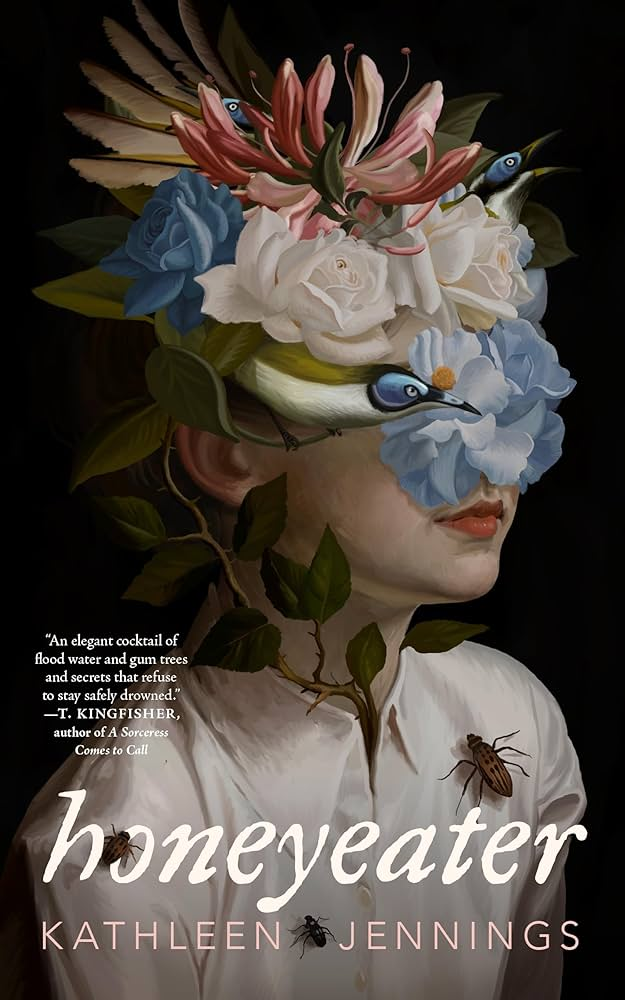
April Book of the Month: honeyeater
Reviewed by Dani Ringrose
Kathleen Jennings is Jacaranda Journal’s guest reader at our first salon for the year! Catch her art and reading from her work at Echo and Bounce in Woolloongabba on May 04, free RSVP here!
My Brisbane street flooded during the 2011 floods. Even after weeks of rain, the water levels moved languidly, a modern gothic uncanny force. It crept out of drains, brown riverine water, carrying sediment and detritus. Brisbane floodwaters may be easier than cyclones or fires to escape, but as the waters’ tongued edges lapped along suburban streets, they felt unstoppable.
Honeyeater, the 2025 urban gothic novel from Brisbane writer Kathleen Jennings, takes this muddy, eddying menace and infuses it with a heady, floral dizziness. It is an exploration of familial obligations, tangled memories and ghosts that won’t stay dead.
The setting of this novel is the fictional town of Gowburgh, a thinly veiled stand-in for Brisbane and its ‘ibis-haunted floodplains’. Those who live along the tentacled reaches of Oxley Creek on Brisbane’s southside—Yeronga, Teneriffe, Graceville, Oxley—will recognise its watery double and the unusual neighbours who appear in this story. Bellworth Creek is a personified force of nature which
finally choked on itself… retched mud, which sprouted teeth, clawed free of weeds, vomited out its own water, and become not-creek. Wet leaves tightened around a restless musculature of vines. It opened its eyes.
Floodwaters can easily snatch things away from us. Relics that are precious to us, things we would rather have sink to the bottom. The protagonist, Charlie Wren, driftless and aimless, is drawn back to his dead aunt’s house along Bellworth Creek. Charlie’s past is littered with missing acquaintances, but that isn’t why he’s returned. He’s come to his aunt’s house to clean it out for good before trying to finally make something of his itinerant-self somewhere else. Which, of course, has nothing to do with the fact that the police are keeping a lazy eye on him.
Charlie’s plans are turned askew as a strange woman appears on the doorstep of the house. Grace is as much a mystery to herself as she is to Charlie. She is an enchanting yet troubled character. For most readers, she is likely to be the most intriguing character, especially after thorny rose vines begin appearing from under her skin, ripping and tangling their way out. The best, witchy descriptions are saved for her transforming appearance:
The lamp, swaying, made her skull look the wrong shape. Blue flowers, grown larger, climbed into her hair and spilled over her shoulder. On her back… that first wound had spread and torn. Its grey fibres frayed like palm matting. Underneath, instead of veins or muscle, wasa a net of blue-green vines. The colours reminded him of the pigeon, and the way it pulled apart—
Like many other gothic narratives, there is often a strong borrowing from the vernacular and tempo of fairy tale and folklore. Jennings uses the stylistics of these genres to make this contemporary tale feel unmoored in time, forcing readers to question what is real.
To add to this folklore-esque atmosphere, the narrative is interrupted by one-page fables or urban myths, narrated as though your grandma is trying to creep you out again with a tale she was told as a little girl. They feel adjacent to the narrative rather than explicit, and are welcome interludes between the dreamlike story.
The themes of the novel, memory and decay, are richly entangled. Everyone has questionable pasts, histories they don’t wish to confront, or a present they don’t understand.
The names of the missing begin to pile up—Alli and her recent, abrupt disappearance; Lydia Damson, childhood friend; Micah, uni buddy—it feels like not being able to see the bottom of a body of water. There’s the desire to keep moving forward, to uncover the truth about these women, to locate their bodies, to lay them all to rest, but there is an undercurrent, a feeling that the riverbed could bottom out at any moment or a bull shark could nip your ankles. The creek’s waters become the key source of mystery and the return of the repressed: ‘[b]ut traffic with the creek isn’t one way. Sometimes things come back. Things, not people.’
Those who worked in the cleanup after those floods—the Mud Army—will tell you of the stench; the sticky clinginess of the mud and silt weeks after the water subsided. The mud was quickly power-hosed from neighbours’ walls and floors, but the rotten smell was pervasive.
This book smells. In the best way.
Jennings’s writing is redolent with the sensory overload of the subtropics. A ripe funk of mangrove mud and indolic vines. The suburb of Bellworth is ‘garlanded with passionfruits’, the ‘vegetal reek of swamps’ and the ‘honey-butter scent of gum flowers’. The story smells of abandonment and decay, both familiar gothic tropes. It smells of the faint violets of your grandmother’s beauty cabinet and the sweetly sour dust of old books. It smells of ghosts who’ve just left the room.
The strength of Jennings’s writing is her ability to craft landscape. Her previous novella, Flyaway, was set in western Queensland where she grew up, and was shortlisted for the 2021 World Fantasy Award and the 2020 Crawford Award. It, too, captured a strong sense of place. Wrought uncanny and fantastical—yet still totally rooted in the real—Jennings’ strengths are continued in the subtropical atmosphere of Bellworth and Honeyeater.
Read if:
you want to know how many bodies wash up
you’re a fantasy fan and want to broaden your reading by trying the subgenres of Australian and suburban gothic
you love writers playing with craft and precisely plucked vocabulary
you crave sensory overload in your books
you don’t have time for a long read: this clocks in at sub-200 pages
you want to support a Brisbane author
What our readers had to say about Honeyeater:
@bettergetkraken on Instagram said,
'It's sublime. I always think of paperbark and snake skin when I think about it.'
Our Next Book
Our May pick for the Behind the Scenes Bookclub will be At the Foot of the Cherry Tree by Japanese-Australian author Alli Parker. Read along with us and send us your thoughts via email or DM on Instagram and TikTok to have them featured in the newsletter. Our review will be out in our May issue!

Kathleen Jennings is an illustrator and writer based in Brisbane, Australia. As an illustrator, she has won one World Fantasy Award (and been a finalist three other times), and has been shortlisted once for the Hugos, and once for the Locus Awards, as well as winning a number of Ditmars. As a writer, she has won a British Fantasy Award (the Sydney J Bounds Award) and two Ditmars and been shortlisted for the World Fantasy Awards, the Locus Awards, the Courier-Mail People’s Choice Book of the Year Award, the Crawford Award, the Australian Shadows Award, the Eugie Foster Memorial Award, and several Aurealis Awards. She has an MPhil and a PhD in Creative Writing. See more of her here.

Dani Ringrose is a sub-editor and salon host for Jacaranda Journal. She is studying her Masters of Writing, Editing and Publishing at UQ. Her debut literary gothic novel The Lyrebirds was shortlisted in 2025 for the Glendower Prize for an unpublished manuscript at the Queensland Literary Awards. Neither of these things would exist if she hadn’t read Kathleen Jennings’s author acknowledgements in Flyaway eight years ago.
Latest from Jacaranda Online
Droolingly Happy: An Interview with Charlie Maycraft
by Cris Bonquin

As I take my first steps into Brisbane’s concrete jungle, I am met with the city’s many peculiarities. The infamous Bin Chicken greets me, as it fervently flounders around for its next feed. The Brisbane Metro snakes around the busways to transport all those who travel within Magandjin.
Sometimes, I cross paths with enlightened figures stepping out of a spiritual experience (12am sweet treats at Pancake Manor). Charlie Maycraft lovingly captures all of Magandjin’s eccentricities in Hot Tarmac, their first-ever solo art show at The Burrow. I chatted with them after the launch night to get more insight into their work.
Charlie is a multi-disciplinary artist based in South Brisbane. They currently hold an artistic residency at Merivale Studios, as well as an operations role to keep the studio running. Merivale Studios is a multi-disciplinary hub for mid-career to established artists in Fish Lane. Their long-term residency there has helped them take their art ‘seriously’...
Cris is a graphic designer and writer based in Magandjin/Brisbane. His series In Review gives readers his perspective on cultural events within Magandjin’s arts community. Outside of his writing, he experiments with mediums like graphic design and photography to develop his artistic practice.
Thank you to the JJ team and to all our readers for another issue of Purple Prose! See you next month!
Newsletter Curator and Columnist:
Jemma Green, Co-Head of Social Media and Marketing
Newsletter Editors:
Talia Wright, Subeditor
Kiv, Subeditor
Euri Glenn, Publisher and Editor in Chief
April Issue Contributors:
Millie Biggs, Co-Head of Social Media and Marketing (recap and reminders)
Dani Ringrose, Salon Supervisor and Subeditor (Honeyeater review)
Cris Bonquin, Arts and Culture Liason (creative spotlight)
Josep Grew Figuerola, Production Assistant (editing)
References for Creativity is a lot like Laundry:
All images sourced from Pinterest.
Parrinder, M. (2000). The Myth of Genius. Eye Magazine, (38).
Paun, G. (2025, April 14). The Power Of Iteration: How Versions Lead To Better Design. Forbes. https://www.forbes.com/councils/forbesagencycouncil/2025/04/14/the-power-of-iteration-how-versions-lead-to-better-design/
Speg, J. (2023, May 26). How to Build Consistency [podcast]. Spotify. https://open.spotify.com/episode/6JNv3C1K5sGgh9PmqPukgL
University of Melbourne. (2022, November 30). The Psychology Behinf Procrastination. https://umsu.unimelb.edu.au/news/article/7797/The-Psychology-Behind-Procrastination/


